The term „Bhagavān“ is used on many instances on our page. But what exactly does it mean? Here is a piece of a historical debate, where one of our Āchāryas provides insight into the meaning of this name of God.
The present article has been published in Journal of Royal Asiatic Society of Great Britain and Ireland, July 1910 [1]. A scanned version of the historical article can be downloaded here.
It is a reaction to a somewhat provocative article by Grierson [2] published earlier in the same journal. Gierson writes:
The full account of what the word „Bhagavan“ means to a Bhagavata will be found in the Viṣṇu Purāna (VI, v. 69 ff). Most of the text is printed in the notes to Wilson’s translation, and it is curious that attention has not been directed to this important passage. The essential part, quoted by all Bhagavatas, is
Translation (from another source): (Bhaga indicates) „the six properties, dominion, might, glory, splendor, wisdom, and dispassion. The purport of the letter va is that elemental spirit in which all beings exist“
This is based on an absurd comparison of bhaya with bhaga, but it is valuable as expressing what a Bhagavata though the name implied. In the 71st verse it is said that the word “Bhagavat” is used in worship “(pūjya padārthōkti-paribhāṣāsamanvitaḥ)” used in a special significance with reference to the Supreme”, i.e. as a name of the Supreme. (…)
For these reasons I do not think that any adjective signifying mere a condition, such as “Blissful” or “Happy” indicates correctly the idea felt by Bhagavatas in applying the word “Bhagavan” to the Supreme. I think we must use some adjective implying worship, or adoration, due to be paid to Him, and here as at the present advised, I think “Adorable” is the most suitable word. If, however, a better one is suggested, I shall be ready to adopt it. These remarks are put forth to invite criticism. The point is not unimportant and if would be well if all scholars could agree on some translation.
Āchārya Govindāchārya Swāmi responds:
The contribution on this topic by Dr. G. A. Girierson in [2] is a good attempt made to approach the sense of the term Bhagavān (or Bhagavat), and then to find the nearest English word for it.
The term Bhagavān is an ancient one, which may be found in the Upaniṣads, and traceable further back to the Vedic deity Bhaga. And according to a grammatical rule, „vat“ can take the place of „mat „, so that Bhagamām becomes Bhagavān.
The intention of the Viṣṇu Purāna, VI, v. 69 ff, is to explain the ancient Mantra, the Dvādaśakṣarī, containing both the terms Bhagavān and Vāsudēva, the latter being traceable to the Viṣṇu / Gāyatrī of the Nārāyaṇam in the Taittrirīya Upaniṣad. In this explanation, the Viṣṇu Purāna takes up Bhagavān first and then Vāsudēva. Bhagavān, according to the definition contained in the verse 79
is „He who is full of auspicious qualities and devoid of inauspicious ones„. That this conception of God is not a later one, enunciated by the Bhagavata school, but is the oldest Vaidic conception, may be learnt from what is called the Ubhaya-liṅgā-dhikaraṅa in the Brahma-Sūtras, extending over III, ii, 11, beginning Na sthānatō’pi to III, ii, 25. The word cannot therefore mean merely „blissful“, qualified subjectively, or merely „holy“, for either of these terms give but a part connotation of the word. „Blessed“ would be better, if it may be understood as an abbreviation for „blessed-qualified“.
The word „Adorable“ only draws out the root-sense, but completely ignores the contents of the definition as given in the Viṣṇu Purāna, verse 79 (above). Parenthetically, the words „used in worship“ on p. 161 ought to be „used for others than Bhagavān for mere courtesy „. I would therefore suggest the following terms with which to translate Bhagavān: „Blessed,“ „Excellent,“ „Best,“ „Perfect,“ „Glorious,“ and perhaps „Lord“. I would leave to my English friends to weigh the different connotations these several terms carry in their lexicon, and choose the best.
Referring to the term Vāsudēva, it is often confounded with the son of Vasudēva (Kṛṣṇa), but read the several connotations of it in the Sahasra-nāma-bhāṣya. Similarly, Kṛṣṇāya Dēvakī-putrāya, of Chāndōgya-Upaniṣad, III, xvii, 6, is by some confounded with Kṛṣṇa, the son Vāsudēva. Śrī Madhvācārya, in his commentary on this Upaniṣad, explains this clearly [3]. There is also a Kṛṣṇa again in the Nārāyaṇam of the Taittirīya-Upaniṣad. This is, again, not to be confounded with Kṛṣṇa, the son of Vasudēva.
A. Govindācārya Svāmi
Veda-Grham, Mysore (S. India)
February 7, 1910
References
[1] The Translation of the Term „Bhagavan“ A. Govindācārya Svāmi The Journal of the Royal Asiatic Society of Great Britain and Ireland Jul., 1910, pp. 861-863, https://www.jstor.org/stable/25189741
[2] The Translation of the Term „Bhagavat“ George A. Grierson The Journal of the Royal Asiatic Society of Great Britain and Ireland Jan., 1910, pp. 159-162, https://www.jstor.org/stable/25189643
[3] See a summary of the points with respect to whether Kṛṣṇa is mentioned in the Upaniṣad at Quora
The line of our early Āchāryas, also known as Sampradāya Pravartaka Āchāryas, is crowned by the appearance of Rāmānuja. Yet, Rāmānuja’s great contributions were not possible without the foundations laid by his great preceptor Yāmunāchārya.
Scholars have found that Rāmānuja’s opus magnum, his comment on the Brahma Sūtras called Śrī Bhāṣya, extensively quotes and paraphrases points made by Yāmunāchārya in his three short philosophical works:
Saṃvatsiddhi, a work that proves that the world we perceive is real (and not essentially an illusion, as argued by the Advaita school).
Āthmasiddhi, a work that proves the existence of the Āthma (which is also seen as not actually existent by the Advaita school).
Īśvarasiddhi, a work that proves the existence of Īśvara, a God that has attributes of a person (and is not a completely impersonal and abstract entity as put forward by the Advaita school).
Probably because the essence of these works is contained in the Śrī Bhāṣya, the fact that the above works by Yāmunāchārya were preserved in a rather incomplete manner and have seen little attention in the last centuries has not bothered the Śrī Vaiṣnava community much. Our interest in these works was kindled when we came across a book about Saṃvatsiddhi by an Austrian Researcher [1], which is only available in German. There is a whole series of books and articles about the early texts of our Sampradaya published in German by a scholar named Gerhard Oberhammer and his PhD candidates / research assistants. We have already mentioned and used these books to provide additional background to the translation of Yāmunāchārya’s Chatuḥślōkī.
We share the general reluctance amongst Hindus in considering academic opinions on our religion. This is because a lot of research is made with a certain hyper-sceptic rationalist-atheist mindset, which is not at all receptive for the deep meanings and subtleties our spiritual heritage has. However, reading the works of Oberhammer, we cannot find that he (or his affiliated researchers) follow such an agendea. Their aim is to shed light on the theological and philosophical genesis of our lineage and they do so in a respectful way.
The book on Saṃvatsiddhi we found seeks to reconstruct as much of the content as possible. This is done by looking for references from the existing fragments to lost parts of the text, as well by comparing the text to sections of the Śrī Bhāṣya with similar content. Since Rāmānuja has build on Yāmunā’s works and likely had them in complete form, the Śrī Bhāṣya could contain glimpses into the lost parts of Saṃvatsiddhi.
Text structure
Here is the general structure of the text, as far as can be inferred / reconstructed from the available palm leafs.
Lost: A detailed exposition of the opposing Advaita argument. The researcher infers that the early Advaita scholar Maṇḍanamiśra (around 700 C.E.) could be the main proponent of the views Yāmuna seeks to rebuke, as this scholar rejected the view that cognition via the senses can be a proper basis for difference, i.e. for non-advaitic standpoints.
Lost: Arguments leading the discussion from whether the world has any degree of reality to the question whether the world has an existence of its own, i.e. if it is in any meaningful way different from Brahman. Most likely, the opposing view is presenting the statement ekam eva advitīyaṃ brahma as reason why this is not the case.
Preserved: Argumentation of Yāmuna why „there is no world different from Brahman“ is not the proper meaning of ekam eva advitīyaṃ .
Preserved: Jaina and other arguments that the world is both nonexistuing and existing or neither of both
Partly preserved: Argumentation of Yāmuna that the Sāṃkhya view resolves this.
– Article part 1 ends here –
Section 2:The reality of the perceiver of the world
Lost: Arguments about the entity which perceives the word, leading to a discussion about tat tvam asi
Preserved: Yāmuna refutes the view that tat and tvam have an identical mode of being, hence the quest of making deductions about the world is meaningful – as there is a proper agent for that quest.
Section 3:The validiy of deductions about the world
Preserved: Yāmuna presents the view that it is possible to draw meaningful conclusions from observations of the world
Preserved: Presentation of advaitic / crytpo-Buddhist views that this is not possible
Preserved: Yāmuna refutes these views with side discussions on the nature and foundations of Avidiya, a core principle of Advaita teachings.
– Article part 2 (to be written) ends here –
Preserved: Presentation of orthodox Buddhist views on the impossibility of deductions on the world (essentially, that the world is resulting from consciousness and has no reality beyond that)
Partly preserved: Yāmuna pointing to logical inconstencies in this view. As Buddhists are not accepting the Vedas or Vedic sciences like Mīmāṃsā, the discussion here is purely based on logic. The surviving text breaks off at some point.
Preserved: Discussions around whether it would be possible to identify defects in the perception of the world according to Yāmuna’s arguments.
Lost: final conclusions, closing remarks
The current beginning and lost sections
All available palm leafs start with ekamevādvitīyaṃ tadbrahmetyupaniṣadvacaḥ (though some have some invocations prior to it) i.e. with an argument on the meaning of an important verse from the Chāndogya Upaniṣad:
You will find this part usually quoted as ekam eva advitīyaṃ brahma and this is also the subject of disucssion here.
The available text starts with a summary of the argument Yāmuna seeks to refute, called Pūrvapakṣa in the vedic science of logic and argumentation (Mīmāṃsā). Mīmāṃsā requires that before a Pūrvapakṣa, an exposition of the opposing argument is to be made (called Saṃśaya) and before that, a quotation of the vedic text on which the argument is made (called Viṣayavākya) is required.
So, at the very least, Saṃśaya and Viṣayavākya were lost. But shortly after the discussions about ekam eva advitīyaṃ brahma, Yāmuna refers to other arguments he has refuted in detail. Hence, the researcher concludes that a whole section with Yāmuna’s proposition, counter arguments, Yāmuna’s arguments against these arguments and his conclusion has been lost, which came before the lost Saṃśaya and Viṣayavākya on ekam eva advitīyaṃ brahma.
Within the text, the text breaks off at two instances, as it jumps to unrelated discussions from a consistent stream of arguments. Also at the end, the text stops without any concluding remarks. This means that besides start and end, also two sections of palm leafs from within the text were likely lost, as shown in the summary table above.
The researcher finds evidence that all existing palm leafs were all copied from a single source in bad shape, as they share certain strange / implausible words at some points, which could be explained as result of writers (who were focused on copying the words and not on their meaning) inferring words at places where the source palm leaf was unreadable. Also, there is a strange break and later contiuation of an argument in all existing palm leafs, which is likely the result of the order of source palm leaf being mixed up (there is no numbering).
Knowing that texts located in Śrī Raṇgam (and other temples) had to be taken out in a rush to save them from the destruction by Muslim invadors, it is not hard to imagine how a loss of palm leafs and the mix up of certain leafs could have happened.
Existing text (consolidated) and translation
Section 1: The reality of the world
subsection: does the world have a meaningful existence of its own?
We give a numbering of the verses for better orientation. As mentioned, the original text has no verse numbers.
ekam evādvitīyaṃ tad brahmety upaniṣadvacaḥ | brahmaṇo ’nyasya sabdbhāvaṃ nanu tat prariṣadhati || 1 atra brūmo ‚dvitīyoktau samāsaḥ ko vivakṣitaḥ | kiṃsvit tatpuruṣaḥ kiṃ vā bahuvrīhir athocyatām || 2
The statment ekam evādvitīyaṃ, this Brahman is one only, advitīyaṃ, made in the Upaniṣad, negates the existence of anything different from Brahman. We respond to this: Which [Sanskrit] compound is meant with advitīyaṃ, shall we call it a Tatpuruṣa [Samas] or a Bahuvrīhi [Samas]?
pūrvasminn uttaras tāvat prādhānyena vivakṣyate | padārthas tatra tad brahma tato ’nyat sadṛśaṃ tu vā || 3 tadviruddam atho vā syāt triṣv apy anayan na bādhate | anyatve sadṛśatve vā dvirtīyaṃ siddhyati dhruvam || 4
The ending part [of a word] is considered superior to the beginning (the scholar references grammarian Patañjali’s work Mahābhāṣya II.1.6 as a source for this statement). The subject of the word is the Brahman. Something different from him, similar to it, or something that is in opposition are all conceivable. In all three cases something other is not impossible. Both in difference and similarity, there is a second.
If Brahman is in opposition to a second, Brahman has a third to it or is the one, as there is only opposition to the second. [We have to keep in mind that Sanskrit has a distinct dual case, which is used in the statement]. So together with the one, all other groups of objects beginning with the third are not revoked, if they are in contact with the second.
nanu nañ brahmaṇo ’nyasya sarvasyaiva niṣedhakam | dvitīyagrahaṇaṃ yasmāt sarvasyavopalakṣaṇam || 7 naivaṃ viṣedho na hy asmād dvidīyasyāvagamyate | tato ’nyat tadviruddhaṃ vā sadṛśaṃ vātra vakti saḥ || 8
(Likely objection by the opponent) The negation (advitīyaṃ) includes everything different from Brahman, as the expression „a second“ means everything else by implication. (Response by Yāmuāchārya) This is not the case. It does not exclude a second. This [Tatpuruṣa Samas] means here something different from him, something in opposition to him or something similar.
If the meaning is „only that which does not have a second, this is Brahman“, the [Śruti] statements like satya would be no meaningful characterization. (Because Brahman would be mainly defined by an attribute (no second), not by his inherent properties). Would advitīyaṃ just relate to the non-existence of a second object, the meaning of the negation particle would relate to itsself and not to the word Brahman.
dvitīyaśūnyatā tatra brahmaṇo na viśeṣaṇam | viśeṣaṇe vā tadbrahma tṛtīyaṃ prathamaṃ tu vā || 11 prasaktaṃ pūrvavatsarvaṃ bahurvīhau samasyati | brahmaṇaḥ prathamā ye ca tṛtīyādyā jagatrtraye || 12 brahma praty advitīyatvāt svasthās tiṣṭhanty abādhitāḥ |
In this case the not-having-a-second not is no attributive definition of Brahman, and if it would be a definition, Brahman would be a first or a third. Everything (that was said in relation to advitīyaṃ being a Tatpuruṣa Samas) follows necessarily if we understand advitīyaṃ as Bahuvrīhi Samas. Because [Brahman is] free from a second, the first, third etc [group of things] which relate to Brahman in the threefold world, remain unchanged and uncanceled.
kiṃca tatra bahuvrīhau samāse saṃśrite sati || 13 vṛttyarthasya nañarthasya na padārthāntarānvayaḥ | saty arthāntarasambandhe ṣaṣṭhī yasyeti yujyate || 14
And if we take the Bahuvrīhi for that part, the meaning of the Sama, if it has the meaning of a negation, has no sytactic relation to another word. (The scholar references Pāṇini II.2.24 as source of this rule). [Only] if a connection to another object esists, the Genitive „whose is“ is correct.
dvitīyavastunāstitvaṃ na brahma na viśeṣaṇam | asattvānna hyasadbrahma bhavennāpi viśeṣaṇam || 15 tasmātprapañcasadbhāvo nādvaitaśrutibādhitaḥ | svapramāṇabalātsiddhaḥ śrutyā cāpyanumoditaḥ || 16
The non-being of a second thing is neither Brahman nor an attributive defintion [of Brahman]. Because it is not, the non-being cannot be Brahman or his attributive defintion. Hence, the reality of senses is not cancelled by this Śruti statement on „non-duality“, instead it is confirmed by the appropriate means of cognition [our perception] and confirmed by the Śruti.
The Śruti statement [ekam eva advitīyaṃ brahma] thus means that there is no second [object] to be mentioned besides him – in the past, present or future. But only that is counted as second, which is at the same level as him or superior. As this world is but a tiny fragment of his unfolding – how could it cound as second to him?
As the claim „the Cola king is the soverein over the world without a second“ has the purpose to exclude a [second] king with similar power, but not [the existence of] ministers, sons, wifes etc. Similarly [the statement ekam eva advitīyaṃ brahma does not exclude] millions of Devas, Demons, Humans, Brahmās, Brahmāṇḍas, which are but a drop in the ocean of Viṣṇus power, unaffected by impurities, [good and bad] deeds and their results etc, lord of all and quintessence of the six qualities, knowledge etc and majestic beyond words.
kaḥ khalvaṅgulibhaṅgena samudrān saptasaṅkhyā | gaṇayan gaṇayedūrmiphenabudbudavipruṣaḥ || 23 yathaika eva savitā na dvitīyo nabhaḥsthale | ityuktā na hi sāvitrā niṣidhyante ‚tra raśmayaḥ || 24
Who would, if he counts the oceans, seven in number, with the help of his fingers, also count the droplets of foam and bubbles? Also the existence of rays is not contested by the statement „there is just one sun and no second at the sky“.
As a number that is existing separately is not counted is within a set of numbers or an object different from that we seek to count, also the [Śruti] teaching „all beings are one-fourth of him; his otherthree-fourths, immortal, in heaven“ (Rig Veda 10.90.3 (Puruṣa Sukta)) includes the whole world in its so-being.
tathā, etāvān asya mahimā tato jyāyastaro hi saḥ | yatrānyan na vijānāti sa bhūmodaram antaram | kurute ’sya bhayaṃ vyaktamityādiśrutayaḥ parāḥ || 27 meror ivāṇur yasyedaṃ brahmāṇḍam akhilaṃ jagat | ityādikāḥ samastasya taditthambhāvatāparāḥ || 28
Similarly, other places in Śruti teach „so grand is his majesty, he is indeed more powerful than this [world].“, „Where you cannot recognize anything else, there is the highest being“, „If he makes a difference, fear is recognised by him“. Also places like „Of the brahmāṇḍa (a complete universe with heavens, mid-worlds like this one and hells) this world is like an atom to mount Meru. All of this relates to everything being in his being.
vācārambhaṇamātraṃ tu jagat sthāvarajaṅgamam | vikārajātaṃ, kūṭasthaṃ mūlakāraṇameva sat || 29 ananyat kāraṇāt kāryaṃ pāvakād visphuliṅgavat | mṛttikālohabījādinānādṛṣṭāntavistaraiḥ || 30
Being Modification, the moving an unmoving world is just based on the word. The immutable root-cause is being. The effect is not different from the cause, as the spark is not different from the fire.
By the abundance of different examples like of clay, iron, seed and by statements in scripture like „by the swelling of its power, fire could not burn gras, water could not sink it, wind was unable to shake it“. „By the recognition of a highest everything else would be known“. (The first point likely refers Chandogya Upanishad section 6.1, verse 4 (yathā somyaikena mṛtpiṇḍena …) while the second refers to the story of Agni not being able to ignite a blade of grass and Vayu not being able blow it away told in Kena Upanishad part 3 beginning with verse 16. ) By these texts and authoritaive texts based on them it is recognised that this world, which us made up of spiritual and non-spiritual things, gets its being from Brahman being their self. Hence, the power of Brahman to bring things into being is not negated.
Negating this would make everything untrue and destroy the meandingful use of words – both in worldy and Vedic context. The same would be true for the perception of Brahman. The teaching that perception and other means of knowledge are untrue while not in conflict with the perception of the world has already been refuted.
Hence we conclude that perception via the senses is not canceled by the Upanishad statement that Brahman does not have a second. Instead, it is the unfolding of the creative power of Brahman.
Subsection: discussion of claims that the world does not actually exist
But if the world is existing, how can the idea „it exists not“ come about? And vice versa, if the world is non-existing, how can the idea „it does exist“ come about? One thing that is existing and non-existing is impossible.
Because of the occurance of this conflicting pair of statements, which is generated by the idea of existing and non-existing, a decision [which one is correct] cannot be made, and hence the Jainas claim that the world is existing and non-existing.
In contrast to this, the Sāṃkhyas always accepted that the world is everlasting because the idea „it exists not“ can only be formed after the existence was recognized. In order to resolve incompatibility in case of a narrow[ly defined] duality, which comes due to the ideas of existing and non-existing, some – because they discarded both parts of the statement – said that the world is neither existing nor nonexisting.
Others insist that things like a pot are sepaerately existing and non-existing because of differences in space and time. But while the representants of the different schools wear each other out in arguments, we still come to a conclusion with the help of the teachings of Mīmāṃsa.
ghaṭasvarūpe nāstitvamastitvaṃ yadyabūbudhat | syādeva yugapatsattvamasattvaṃ ca ghaṭādiṣu || 44 idānīm idam atrāsti nāstītyevaṃvidhā yataḥ | deśakāladaśābhedād astināstīti no dhiyaḥ || 45
If one has with regard to the nature of the pot recognized that it exists and does not exist, a parallel occurrence and non-occurrence of the pot and other things could exist. Our concepts of „it exists“ and „it exists not“ are as follows: [We think] „now it exists here“ or „now it exists here not“, hence we have the idea about the pot etc that it exists or does not exist in distinctions of space and time.
ato deśādibhedena sadasattvaṃ ghaṭādiṣu | vyavasthitaṃ nirastatvād vādasyeha na sambhavaḥ || 46 nanu deśādisambandhaḥ sata evopapadyate | na deśakālasambandhādasataḥ sattvam iṣyate || 47
The Jaina teaching (that the world is existing and non exististing at the same time) is thus not possible and was refuted. [Objection] The connection with factors like space and time is only possible for things in being. We do not assume that non-being things come into being due to connections with space and time.
Connections have two real substrates . Hence, something that exists is always existing. But that something non-being comes into being due to causal factors is utterly imposssible. The world of senses with its beginning and end hence falls into the area of the being. Because it is taught „what does neither exist in the beginning nor the end, does not exists in between“. (This may refer to statements like Bhagavad Gīta Chapter 2. verse 16: „The unreal has no being, the real has no non-being. The essence of both is seen by the truth-seers“.) Hence, that what is found to be being is always being.
That what is non-being is always non-being due to the impossibility of coming into being. On that what is non-being, there is no difference between a previous non-being and a permanent non-being.
With the next verse, the discussion jumps to the topic of the meaning of the mahavakya tat tvam asi. The scholar argues that this jump makes no sense from the perspective of the preceding discussion, hence it is an indication for a lost section of the Saṃvatsiddhi. We agree with him. The discusussion on tat tvam asiwill be presented in Saṃvatsiddhi Part 2.
Adiyēn Mādhava Rāmānuja Dāsan
References
[1] Yāmunācāryas Saṃvatsiddhi – Kritische Edition, Übersetzung und Anmerkungen. Mit einem Rekonstruktionsversuch der verlorenen Abschnitte – Roqie Mesquita, Verlag der Österreichischen Akademie der Wissenschaften. Wien 1988
Es ist wohl kaum möglich die Bedeutung, die der große Āchārya Rāmānuja für unsere Tradition hat, zu überschätzen. Daher ist es umso bemerkenswerter, dass seine Texte im Allgemeinen nicht die Schwerpunkte der Lese- und Rezitationspraxis der meisten Śrī Vaiṣṇavas sind. Das liegt daran, dass unter den neun Texten, die Rāmānuja uns hinterlassen hat, fünf anspruchsvolle philosophische Schriften sind:
Vedārtha Saṅgrahaḥ, dies bedeutet „Zusammenfassung der Bedeutung der Veden“. Dieser Text ist vermutlich der erste Text, den Rāmānuja veröffentlicht hat – er beschreibt die philophische Position unserer Tradition in Abgrenzung zur Advaita Philosophie und anderen Denkschulen, siehe dazu auch unsere Philosophie. Eine englische Zusammenfassung ist hier verfügbar.
Śrī Bhāshya, der Kommentar unserer Traditon zum Brahma Sūtra, einem kryptischen, aber von allen Hindu-Linien als authoritativ angesehenen Text, der scheinbare Widersprüche zwischen den verschiedenen vedischen Texten auflöst.
Bhagavad Gītā Bhāshya, ein Kommentar zur Bhagavad Gītā. Rāmānuja hat hier allem Anschein nach die Denklinien, die sein Guru Yamunāchārya in seiner Zusammenfassung der Gītā, demGītārtha Saṅgrahaḥ angelegt hat, aufgenommen und erweitert. Eine englische Übersetzung ist unter githa.koyil.org verfügbar.
Vedāntadipa, eine kurze Zusammenfassung des Śrī Bhāshya.
Vedāntasāra, eine etwas ausführlichere Zusammenfassung des Śrī Bhāshya.
Diese Texte sind alle mehr oder weniger schwere Kost für Leser, die sich nicht schon lange mit Vedanta beschäftigen und sich in den Vedischen Texten gut auskennen. Aus diesem Grund gibt es Kommentare / weitergehende Erläuterungen dieser Texte, die sie „normalen“ Lesern erst verständlich machen, aber die Texte auf hunderte Seiten dichter Philosophie und Logik ausdehnen. Dies macht die nicht-wissenschaftlichen Texte von Rāmānuja, die drei Gadyams, für uns so wertvoll. Ein Gadyam ist Text, der keine Reime nutzt, aber trotzdem eine harmonische und melodische Sprache hat. Die Gadyams sind verhältnismäßig kurz und einfach, vermitteln aber trotzdem tiefe Einblicke in das Denken und die spirituelle Stimmung von Rāmānuja. Die Namen der Gadyams sind wie folgt:
Saranāgati Gadyam
Śrīranga Gadyam
Śrīvaikunta Gadyam
Das Śrīranga Gadyam ist unter diesen drei Texten der kürzeste und befasst sich mit der Verehrung von Śrī Raṅganatha – also dieselbe Bildgestalt, die auch im Thirumālai und im Amalanādhipirān besungen wurde.
Hier eine sehr schöne Rezitation des Śrīranga Gadyams:
Thanian
chidhachithparathathvānāṃ tattvayāthāthmyavedine | rāmānujāya munaye namo mama garīyase ||
Er, der die wahre Natur der drei Tattvas, der bewussten und der unbewussten Einheiten (Chit / Achit) und der höchsten Einheit (Param, Śrīman Nārāyaṇa) kennt, Rāmānuja, der Weise (Muni), der große Lehrer, ich verbeuge mich vor Ihm.
Du selbst kontrollierst die drei Arten der bewussten Wesen (baddha, mukta und nitya Āthmās, also gebundene, befreite und ewig freie Āthmās), ihre grundlegende Natur, ihre Aktiväten, Erhaltung und ihre Unterschiede.
kleśa karmādhyaśeṣa doshāsamspṛṣṭaṃ,
Leid, vergangene Taten und all das, es lässt keine Spur, all die Fehler, sie berühren ihn (der als Überseele im Innersten des Āthmā weilt) nicht.
Sie ist Einfachheit (die Natur von Nārāyaṇa ist es, keinen Unterschied zwischen ihm und anderen zu sehen), Verzeihen (vāthsalya – er trägt seinen Anhängen ihre Fehler nicht nach, sondern entfernt sie), Weichheit (obwohl seine Macht grenzenlos ist, zwingt er seine Anhänger nicht, bei ihm zu bleiben. Verlassen sie ihn, ist er betrübt – er nutzt seine Macht nicht, um sie zum Bleiben zu zwingen), Ehrlichkeit, gute Wünsche für alle, er bevorzugt niemanden wegen seiner Herkunft oder seinen Handlungen, Fülle an Mitleid, Eleganz, voller Tiefe, Wunscherfüller, voller Vergebung, der Beständige (wenn er einmal den Beschluss gefasst hat, einen seiner Anhänger zu schützen, kann ihn nichts davon wieder abbringen).
dhairya śaurya parākrama
Sie (deine Natur) ist Wagemut, Heldenmut und die Fähigkeit zu Führen,
sathyakāma sathyasankalpa kṛtitva kruthajñādyā
(Für Deine Anhänger bis Du) die wahre Sehnsucht und der wahre Geistesfokus,
asankhyeyakalyāṇa guṇagaṇougha mahārṇavaṃ,
unzählbare glückbringende Eigenschaften, ganze Bündel solcher Eigenschaften, Wellen und Fluten von ihnen, ein ganzer Ozean.
parabrahmabhutham,
Du bist das höchste, das absolute Wesen,
puruṣottamam,
Du bist der Herr der Purushas (gebundene Āthmās, befreite Āthmās, ewig freie Āthmās, siehe oben).
śrīranga śāyinam,
Der, der in Śrī Rangam für alle sichtbar ist (anstatt unnahbar im Transzendentalen zu weilen)
Geboren aus dieser Erfahrung, grenzenlos, erhaben, ganz und gar und hervorgebracht durch Liebe, mache mich zu Deinem Diener, erfüllt von Liebe, und im rechten Zustand, der rückhaltlos zu Deinen Diensten ist.
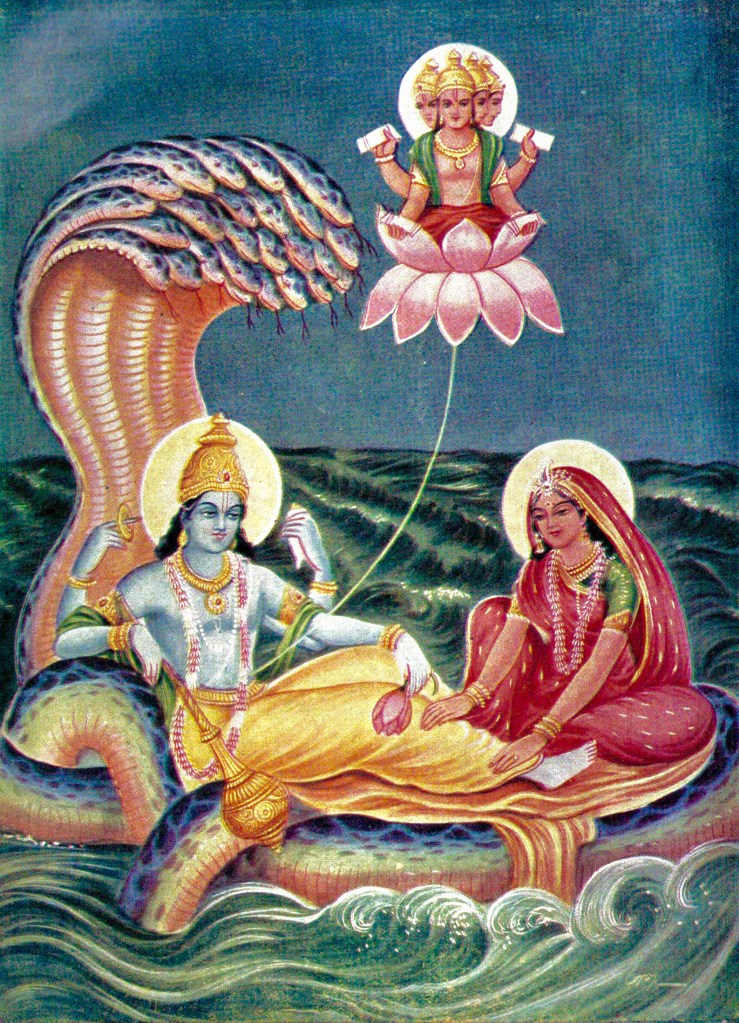
Śrīman Nārāyaṇa mit Mahālakshmī, aus dem Nabel Nārāyaṇas entspringt der Demiure Brahma
Der erste Abschnitt ist laut unseren Āchāryas eine Wiederholung des ersten Churnais. Rāmānuja wiederholt noch einmal, dass er der Diener des Herren ist und dies seine Natur ist. Er wiederholt auch in kurzer Form noch einmal die Attribute des Herren, die oben bereits ausführlich beschrieben wurden. Die lebendige Erfahrung dieser Attribute erweckt in ihm das Verlangen nach ununterbrochenenen, liebevollen Dienst am Herren:
nithya kainkarya prāpthyupāya bhūtha bhakthi
Der ewigen Dienst, er wird erreicht durch reine Hingabe.
thadhupāya samyak gyāna,
Diese Hingabe wird erreicht durch wohlgeformtes Wissen.
Anstatt der Weisheit und der guten Taten, die für Bhakti und die Erfahrung der wunderbaren Qualitäten des Herrn nötig sind, habe ich das falsche Wissen und und tue falschen Taten, im großen Ozean (von Samsara, dem Kreislauf aus Tod und Wiedergeburt) bin ich versunken.
thilathailavath dhāruvahnivathdhurvivecha
So wie das Öl nicht vom Sesam und das Feuer nicht vom Dhāru (einer bestimmten Holzart) getrennt werden kann…
thriguṇa kshaṇaksharaṇa svabhāva
… so sind es die drei Guṇas im Moment des Wechsels (wenn das Āthma wieder einen physischen Körper annimmt).
achethana prakruthi vyāpthi rūpa
Unbewusste Materie, überall verteilt (das Āthma ist mit ihr verbunden, so lange es in Samsāra weilt).
dhurathyayabhagavanmāyā thirohitha svaprākaśa:
Dieser Schleier des Herrn, er versteckt das, was aus sich leuchtet.
Er ist ein Ozean der Gnade, ohne Grenzen. Er unterscheidet nicht, den Menschen Zuflucht, ohne etwas zurück zu lassen. Er entfernt die Trübsal seiner Anhänger, seine Zuneigung für die, die von ihm abhängen, ist groß wie der Ozean.
Mein wahres Verlangen! Mein wahrer Geistesfokus! Mein Freund in Gefahr! Nachkomme von Kākuthstha (ein Name von Rāma)! Śrīman – der Ehemann von Śrī, Nārāyaṇa Höchstes aller Wesen Herr von Śrīrangam! Mein Herr! Ich verneige mich vor Dir!
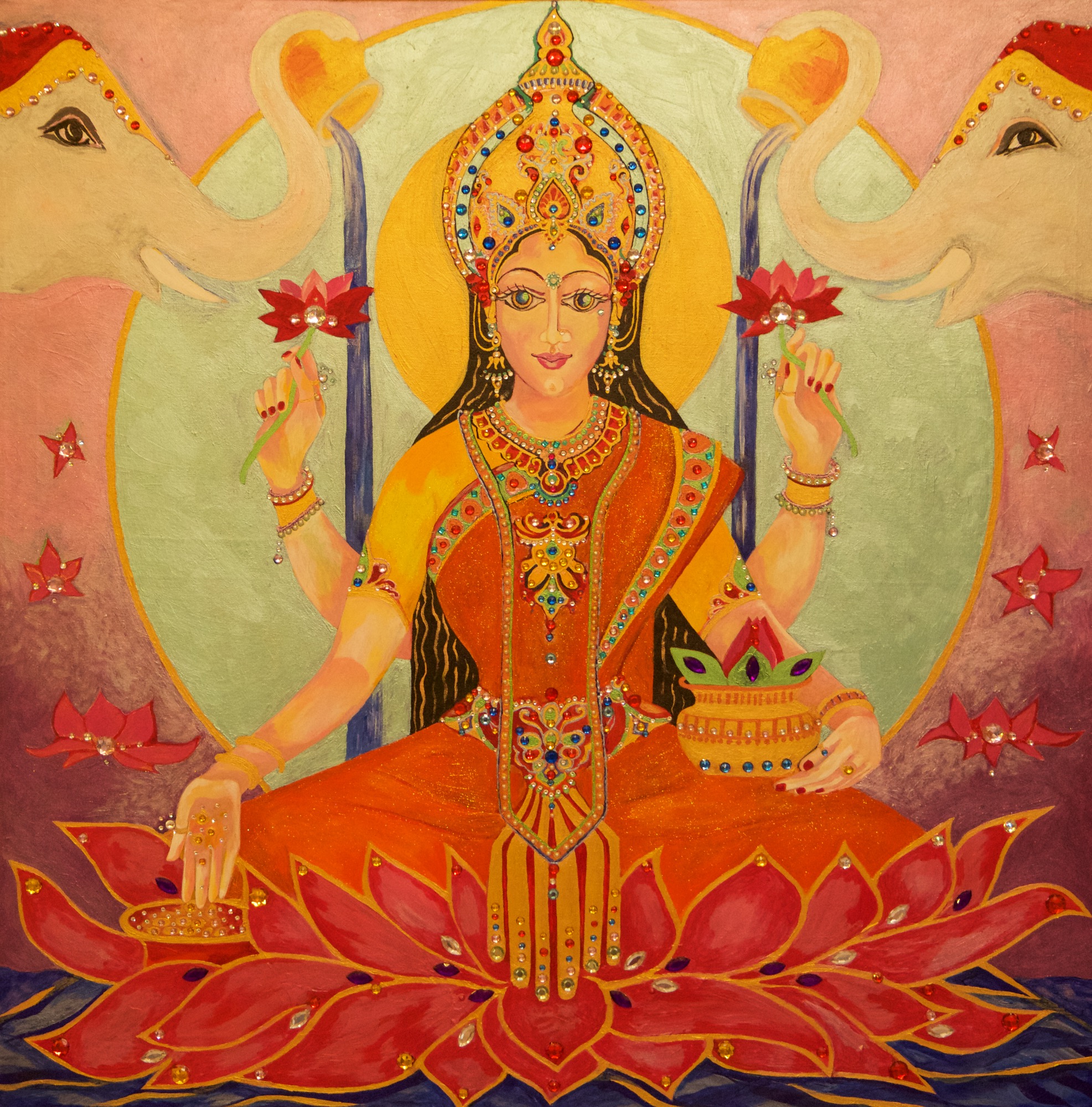
The name of our tradition (Śrī Vaiṣṇavam) already indicates that we worhship divine mother Lakṣmī, whose short name is Śrī. Other Vaiṣṇava lineages also worship a motherly mediator between Bhagavan and Āthmās (for example, Rādha in the Hare Krishna lineage), but it seems fair to say that the theology of the goddess is most highly refined in our lineage.
This fact has not escaped the attention of academic researchers. We find in Oberhammer [1] an examination of the oldest surviving fragments of teachings about Lakṣmī in our tradition. In this examination, Yāmunāchārya’s Chatuḥślōkī is highlighted as the oldest complete text on the worship of Lakṣmī in our lineage. Oberhammer notes his surprise that it already conveys a full theology of the goddess. In Dhavamoney [2] we find a theological analysis of Chatuḥślōkī. And there is of course also some commentary work on this work within our own tradition, for example by Periyavāccan Piḷḷai.
In the line of our teachers, Yāmunāchārya (Tamil name Āḷvandhār) is the 4th Āchārya after the start of the “new” teaching tradition with Nāthamuni. Nāthamuni probably lived around the middle of the 9th century C.E.. Yāmunāchārya (early 10th century) saw Rāmānuja from a distance, but died on the very day Rāmānuja came to him to become his disciple.
Yāmunāchārya left us other important Stotrams (hymns) beside Chatuḥślōkī and some smaller scientific works. Rāmānuja’s work focuses on scientific texts, i.e. texts on Vedanta topics in the classical form of Indian spiritual science treatises: thesis – criticism of thesis – answer to criticism – conclusion. It is said that Rāmānuja thus followed the wish of Yāmunāchārya, who wanted to write such works but could not do so because of his poor health and advanced age. Academic researchers pointed out an extremely close link between the thinking of these two great Āchāryas. They find that Rāmānuja precisely continued the lines set out by Yāmunāchārya – almost like one Āchārya in two bodies!
So let us immerse ourselves in a text that is about 1000 years old. A text which makes the glory of our divine mother Śrī shine so wonderfully that no comparable text has been written in this long time. We give a synthesis of the translation on our mother site koyil.org [3] with the academic translations from [1], p.120 and [2]. We attempt to make the translation as literal as possible while preserving much of the beauty of the koyil.org translation.
Honoratory verse (Thaniyan)
Written by Rāmānuja, this verse leads many works of Rāmānuja.
yat padāmbhōruhadhyāna vidhvasthāśēṣa kalmaṣaḥ vastutāmupayā thō’haṃ yāmunēyaṃ namāmi tam
I worship Yāmunāchārya, through whose mercy all my defects have been removed and I awoke from false identification. I recognized my true nature as Sat, as eternal Āthmā, by meditating on the lotus feet of Yāmunāchārya.
Your consort is puruṣottamaḥ, the supreme being, (and, as for him) your bed and seat is the lord of serpents (Adiśeṣa), Your vehicle is the Lord of the birds, the guardian of the Vedas (Garuḍa), your veil is Māyā, which blinds the world. Brahmā, Īśa (Śiva) and their companions are your servants like the other gods, Śrī is your name, oh sublime one, but how can words praise your splendour?
The divine mother Śrī thus shares the decisive insignia of the supreme being, which we commonly call Nārāyaṇa (Nāra* = human being, *ayaṇa = refuge).
Verse 2
yasyāste mahimānamātman iva tvadvallabho’pi prabhuḥ nālam mātumiyattayā niravadhiṃ nityānukūlam svathaḥ | tām tvām dāsa iti prapanna iti cha stoṣyāmyahaṃ nirbhayaḥ lokaikeśvari lokanāthadayithe dānte dayām te vidan ||
Your greatness exceeds even that which can be measured by your beloved (Nārāyaṇa), just like his own greatness. You are always most compassionate towards us and so I praise you without fear! I am your servant, you are my refuge; I know that your love is only for the One (Nārāyaṇa), mother of the world, beloved of the ruler of the world, so I speak, for I know your grace.
While the universal ruler Nārāyana mostly takes on the role of the father, who rewards and judges according to merits and misdemeanors, the divine mother Śrī takes on the role of the mother, who sees only the good in beings and pleads for forbearance. So while we should treat Nārāyana with utter respect and be fearful to be punished for our shortcomings, fear is inappropriate towards mother Śrī.
Through a trace of the nectar of your compassionate gaze, the three worlds are preserved. Without it, they were in destruction, through your gaze they now blossom again and without limits. Without your grace, so dear to the lotus-eyed (Nārāyaṇa), no happiness can be found, neither in the material enjoyment of Saṃsāra, nor in the meditation on the unmanifest (the experience of the blissful aspects of Āthmā, as practiced in many Yoga paths and Buddhism) nor in the path of Vaiṣṇavas (the aspiration of eternal service to Śrīman Nārāyaṇa).
The form of Hari (Nārāyaṇa) is the highest Brahman, infinite, peaceful and immensely unfolded, also the embodied Brahman, his lovable, wonderful figure (i.e. the avatars he takes for his divine activities) and all the other forms of himself that He takes at will, all of these are deeply interwoven with your own glory.
I adore her, the beloved of Varadha Perumal, adorned by loving service and complete dependence on him. Only he enjoys her qualities, he in whom all things rest and from whom everything develops.
[2] Mariasusai Dhavamoney: Yāmuna’s Catusślokī: an analysis and interpretation. Indologica Taurinensia VOLUME III-IV (1975-1976), Proceedings of the „Second World Sanskrit Conference“ (Torino, 9-15 June 1975)
Adiyen Mādhava Rāmānuja Dāsan Edition of the koyil.org translation for a non-indian audience, integration of academic translations Adiyen Sarathy Rāmānuja Dāsan Adiyen Vangīpuram Satakōpa Rāmānuja Dāsan Translation of the tamil translation into English
Der Name unserer Tradition (Śrī Vaiṣṇavam) deutet bereits darauf hin, dass wir die göttliche Mutter Lakṣmī, deren Kurzname Śrī ist, sehr verehren. Auch die anderen Linien der Vaiṣṇavas verehren eine mütterliche Mittlerin zwischen Gott und den Āthmās (in der Hare Krishna Linie z.B. Rādha), doch man kann wohl sagen, dass die Theologie der Göttin in unserer Line an Detaillierung und Ausarbeitung kaum zu übertreffen ist.
Dies ist der akademischen Indologie nicht entgangen und so finden wir bei Oberhammer [1] eine Untersuchung der ältesten erhaltenen Textfragmente zur Lehre von Lakṣmī in unserer Tradition. In dieser Untersuchung wird die Chatuḥślōkī von Yāmunāchārya als ältester vollständig erhaltener Text zur Verehrung von Lakṣmī genannt und bemerkt, dass dieser bereits eine voll ausgearbeitete Theologie der Göttin vermittelt. Bei Dhavamoney [2] finden wir eine akademische Analyse des Inhalts der Chatuḥślōkī. Darüber hinaus gibt es natürlich eine Kommentierung und Interpretation innerhalb unserer Tradition, z.B. von Periyavāccan Piḷḷai.
In der Linie unserer Lehrer ist Yāmunāchārya (tamilischer Name Āḷvandhār) der 4. Āchārya nach dem Beginn der „neueren“ Lehrtradition mit Nāthamuni. Letzterer lebte wohl um das 9. Jahrhundert unserer Zeitrechnung. Yāmunāchārya (Anfang 10. Jahrhundert) hat Rāmānuja aus der Ferne gesehen, aber er starb just an dem Tag, als Rāmānuja zu ihm kam, um sein Schüler zu werden.
Während Yāmunāchārya uns wichtige Stotren, also Hymnen, und einige kleinere wissenschaftliche Arbeiten hinterlassen hat, liegt der Schwerpunkt von Rāmānujas Arbeit bei wissenschaftlichen Texten – also Texte zu Fragen des Vedanta in der klassischen wissenschaftlichen Form der indischen Geistestradition: These – Kritiken an These – Antwort auf Kritiken – Schlussfolgerung. Es wird erzählt, dass Rāmānuja damit dem Wunsch von Yāmunāchārya folgte, der mehr solcher Werke schreiben wollte, es aber wegen seiner schwachen Gesundheit und seinem fortgeschrittenen Alter nicht mehr konnte. Indologen wie Oberhammer finden, dass Rāmānuja die von Yāmuna angesetzten Denklinien mit hoher Genauigkeit fortführt, fast so wie ein Āchārya in zwei Körpern.
Tauchen wir also ein in einen ca 1000 Jahre alten Text, der den Ruhm der göttlichen Mutter so wunderbar zum Glänzen bringt, dass in dieser langen Zeit kein vergleichbarer Text mehr geschrieben wurde. Wir präsentieren hier eine Synthese der koyil.org Übersetzung [3] mit der akademischen Übersetzung aus [1], S.120 sowie [2].
Würdigungsvers (Thaniyan)
Gedichtet von Rāmānuja, dieser Vers führt die meisten Werke von Rāmānuja an.
yat padāmbhōruhadhyāna vidhvasthāśēṣa kalmaṣaḥ vastutāmupayā thō’haṃ yāmunēyaṃ namāmi tam
Ich verehre Yāmunāchārya, durch dessen Lotusfüße all meine Defekte entfernt wurden und ich meine wahre Natur als Sat, als ewiges Āthmā, erkannte.
Dein Geliebter ist Puruṣottamaḥ, das höchste Wesen (und wie er ist) Dein Ruhebett der Herr der Schlagen (Adiśeṣa), Dein Gefährt ist der Herr der Vögel, der Hüter der Veden (Garuḍa), Dein Schleier ist Māyā, die die Welt verblendet. Brahmā, Īśa (Śiva) und ihre Gefährtinnen sind wie die anderen Götter Deine Diener, Śrī ist Dein Name, oh Erhabene, aber wie können Wörter Deine Erhabenheit preisen?
Die göttliche Mutter teilt somit die entscheidenen Insignien des Höchsten Wesens, das wir gemeinhin Nārāyaṇa (Nāra* = Mensch, *ayaṇa = Zuflucht) nennen.
Vers 2
yasyāste mahimānamātman iva tvadvallabho’pi prabhuḥ nālam mātumiyattayā niravadhiṃ nityānukūlam svathaḥ | tām tvām dāsa iti prapanna iti cha stoṣyāmyahaṃ nirbhayaḥ lokaikeśvari lokanāthadayithe dānte dayām te vidan ||
Deine Größe übersteigt selbst das, was von Deinem Geliebten (Nārāyaṇa) ermessen werden kann, ganz so wie seine eigene Größe. Stets bist Du uns wohlgesonnen und so preise ich Dich ohne Furcht! Dein Diener bin ich, meine Zuflucht bist Du; Ich weiß, Deine Liebe gilt nur dem Einen (Nārāyaṇa), Mutter der Welt, Geliebte des Weltenherrschers, so spreche ich, denn ich kenne Deinen Güte.
Während der Weltenherrscher Nārāyana zumeist die Rolle des gestrengen Vaters übernimmt, der nach Verdiensten und Vergehen belohnt und richtet, übernimmt die Weltenmutter Śrī zumeist die Rolle der gütigen Mutter, die in den Wesen immer nur das Gute sieht und für Milde plädiert. Während wir also Nārāyana durchaus mit Respekt und Furcht begegnen sollten, ist Furcht bei der göttlichen Mutter unangebracht.
Durch eine Spur des Nektars Deines mitleidvollen Blickes werden die drei Welten bewahrt. Ohne ihn waren sie in vernichtet, durch Deinen Blick erblühen sie nun erneut und ohne Grenzen. Ohne Deine Gnade, die dem Lotusäugigen (Nārāyaṇa) so lieb ist, ist kein Glück zu finden, weder in den materiellen Freunden von Saṃsāra, noch die Meditation auf das Unmanifeste (die Erfahrung der glückseligen Aspekte des Āthmās, wie z.B. im Buddhismus und in vielen Yoga-Wegen praktiziert) noch im Weg der Vaiṣṇavas (das Erstreben des ewigen Dienstes an Śrīman Nārāyaṇa).
Die Form von Hari (Nārāyaṇa) ist das höchst Brahman, unendlich, friedvoll und weit entfaltet, auch das verkörperte Brahman, seine liebenswerte, wunderbare Gestalt (also die Avatare, die er für seine göttlichen Aktivitäten annimmt) und all die anderen Formen seiner selbst, die er nach Belieben annimmt, all diese sind zutiefst verwoben mit Deinen eigenen Entfaltungen.
Ich verehre sie, die Geliebte von Varadha Perumal, geschmückt durch liebenden Dienst und vollkommene Abhängigkeit von ihm. Nur er genießt ihre Qualitäten, er, aus dem alle Dinge ruhen und sich entwickeln.
[2] Mariasusai Dhavamoney: Yāmuna’s Catusślokī: an analysis and interpretation. Indologica Taurinensia VOLUME III-IV (1975-1976), Proceedings of the „Second World Sanskrit Conference“ (Torino, 9-15 June 1975)
Eine frühere Version dieses Artikel bezog sich auf Swami Vishwananda als Beispiel für jemanden, von dem fälschlich behauptet wird, dass er ein Śrī Vaiṣṇava Āchārya sei. Diese Behauptungen wurden mitterweile korrigiert, sodass wir den Artikel so verändert haben, dass er allgemeiner Natur ist.
Unsere Tradition hat eine große Vergangenheit, ist aber auch sehr vielfälig und dezentral organisiert. Diese Mischung führt leider immer wieder dazu, dass Menschen fälschlicherweise behaupten, unsere Tradition zu repräsentieren oder sogar einer unserer Āchāryas (Lehrer, die durch ihr Beispiel lehren) zu sein. Da wir nun einmal vielfältig und dezentral sind, gibt es (leider?) keinen „Rat der Āchāryas“ oder irgend ein anderes zentrales Gremium oder auch nur eine offizielle Liste von Āchāryas, mit der man solche Behauptungen abgleichen könnte.
Es ist aber nicht schwer, falsche Śrī Vaiṣṇava Āchāryas zu erkennen, wenn man weiß worauf man achten muss. Hilfsmittel wie Listen sind daher in aller Regel gar nicht nötig! Die Linie unserer Āchāryas hat nämlich einen absolut klaren Standard gesetzt, wie sich ein Śrī Vaiṣṇava Āchārya verhält – und diesen Standard können die „Möchtegerns“ i.d.R. nicht einmal ansatzweise einhalten. Das Verhalten eines Āchāryas ist allerdings sehr vielfältig und komplex. Dieser Artikel befasst sich daher nur mit den einfachen und relativ offensichtlichen Punkten. Allein diese sollten aber schon ausreichen, um 90%+ aller „Fälschungen“ zu erkennen.
Wir listen im Folgenden einige Themenbereiche auf, anhand derer geprüft werden kann, ob jemand ein Śrī Vaiṣṇava Āchārya ist oder nicht. Dabei ist zu beachten, dass jeder einzelne Punkt ausreicht, um an der Behauptung, dass jemand Śrī Vaiṣṇava Āchārya ist, erhebliche Zweifel zu wecken.
Namen und Titel
Śrī Vaiṣṇavas erhalten einen spirituellen Namen. Dieser Name steht üblicherweise in Beziehung zum Geburtsnamen und wird mit „Rāmānuja Dāsan“ ergänzt, was „Diener Rāmānujas“ bedeutet. Wenn ein Śrī Vaiṣṇava als nachfolgender Āchārya berufen wird, nimmt er einen anderen Namen an, der normalerweise in Beziehung der Linie von Āchāryas steht, die er ab da repräsentiert. Beispiel: Wenn ein Āchārya aus der Linie von Embar kommt, dem Cousin von Rāmānuja, der ihm als Anführer der Tradition nachfolgte, wird er „Embar Jeeyar Swami“ genannt. Der Bezug zu vorangegangenen Āchāryas und erhabenen Śrī Vaiṣṇavas ist sehr wichtig für unsere Traditon. Daher müssen an der Authentizität eines Āchāryas, der nicht auf seinen Āchārya bzw dessen Line Bezug nimmt, größte Zweifel bestehen.
Vaiṣṇavas präsentieren sich normalerweise nicht mit Ehrentiteln. Beispielsweise ist Paramahamsa ist ein üblicher Titel für Sanyasis (entsagte Mönche). Andere Menschen sprechen diese auch durchaus so an, die Bescheidenheit eines Vaiṣṇavas verbietet es ihm aber, sich selbst so zu bezeichnen oder zu präsentieren.
Einweihung
Der Āchārya ist für uns Śrī Vaiṣṇavas sehr wichtig. Sein Thaniyan (rühmender Vers) wird von uns jeden Tag rezitiert, sein Bild hängt an prominenter Stelle in unserer Wohnung – denn wir sind ihm dankbar, dass er uns mit der Kette der Gnade, die von Rāmānuja ausgeht, verbindet. Wenn wir eingeweiht sind, geben wir folglich stets voller Freude an, welcher Āchārya uns eingeweiht hat. Das bedeutet, dass ein Śrī Vaiṣṇava Āchārya den Thaniyan seines Āchāryas rezitieren wird und regelmäßig auf ihn Bezug nehmen wird. Desweiteren kann die Einweihnung nur hier auf der Erde durch einen lebenden Āchārya erfolgen – Einweihungen in der Astralen Sphäre, von denen man heute immer mal wieder hört, werden von uns nicht als echte Einweihngen akzeptiert.
Referenz zu Lehren weit außerhalb unserer Tradition
Da wir uns unserer Tradition verpflichtet fühlen und da es einen reichen Schatz and Begebenheiten aus dem Leben unserer Āḻvārs and Āchāryas gibt, referenzieren Śrī Vaiṣṇavas im Allgemeinen und Śrī Vaiṣṇava Āchāryas im Besonderen nur die vedische Literatur und das reichte Erbe unserer Tradition.
Im Gegensatz dazu nutzen heutige Lehrer oft sehr unterschiedliche Einflüsse und Quellen für ihren Lehren. Das mag den Schülern weltoffen und modern erscheinen, wird von unserer Linie aber strickt abgelehnt.
Zum Bespiel geben dutzende (häuft selbst-proklamierten) Gurus Mahavatar Babaji als seinen Guru oder Mentor an. Mahavatar Babaji ist ein mythenumrankter Yogi, der i.d.R. als Avatar von Śiva gesehen wird. Wir respektieren Śiva als großen Verehrer von Śriman Nārāyana, aber unsere Tradition hält sich strikt davon fern, Śiva zu verehren oder Gemeinschaft mit den Verehrern von Śiva zu pflegen.
Äußere Erscheinung
Śrī Vaiṣṇavas folgen den Schriften so genau wie möglich. Und während normale Anhänger der Tradition, gerade wenn sie außerhalb Indiens leben, im Alltag so einige Kompromisse eingehen, sind unsere Āchāryas in jeder Hinsicht ausgesprochen strikt, denn sie lehren auch durch ihr Beispiel. Im Bezug auf ihre äußere Erscheinung bedeutet das:
Sie tragen Śikhā, das bedeutet ihr Haar ist abraisiert bis auf einen kleinen Haarbüschel am Hinterkopf
Wenn sie den Titel Swami tragen, also ein entsagter Mönch sind, tragen sie keinerlei Gold, Schmuck, Perlen usw.
Sie tragen keine genähte Kleinung. Anstatt dessen tragen sie einen Dhoti und (in kalten Gegenden) ein zweites Stück Stoff, um den Oberkörper abzudecken.
Sie tragen Urdhva Pundra, auch als Thilak bekannt – das ist das rot/weiße Zeichen unserer Tradition auf der Stirn. Sie tragen es genau so, wie ihr Āchārya es ihnen gezeigt hat, d.h. es gibt keine Variation in diesem Zeichen.
Geld
Es ist üblich und korrekt, dass ein Schüler seinem Āchārya ein Geldgeschenk ( Dakshina) gibt. Dies ist aber immer eine freiwillige Gabe und keine Voraussetzung dafür, Unterweisungen zu hören oder eingeweiht zu werden. Unsere Āchāryas haben die höchsten Weisheiten immer kostenlos verkündet! Es kommt natürlich vor, dass ein Āchārya besonders vertrauliche Unterweisungen nur seinen engsten Schülern gibt, aber bei solchen Restriktionen geht es nie um Geld! Wird somit Geld dafür verlangt, überhaupt Unterweisungen zu bekommen, ist das ein klares Warnsignal, dass der betreffende Lehrer nicht authentisch ist.
An older version of this article was focussing on Swami Vishwananda as example for someone claiming to be an Āchārya without being one. This claim has been corrected, so we adjusted the article to be of a general nature.
Our tradition has a great history and is very diverse and de-centralized. This has induced quite a few people to falsely claim to represent (or even be an Āchārya in) our tradition. Being the diverse and de-centralized tradition we are, there is no central decision body nor a list of Āchāryas which could be used to check such claims.
However, it is fairly easy to spot fake Śrī Vaiṣṇava Āchāryas, so auxiliary means are usually not needed. This is because the lineage of our Āchāryas has set a crystal clear standard on how a Śrī Vaiṣṇava Āchāryas behaves. As the behaviour of an Āchārya is very intricate and complex, we shall restrict outselves on rather obvious and simple points, which are easy to understand but should still suffice to spot 90%+ of all fake Śrī Vaiṣṇava Āchāryas.
Following, we give a list of points to check claims that someone is a Śrī Vaiṣṇava Āchārya. Each and every point is by itsself sufficient to cast severe doubts that the respective person is an Āchārya.
Name & Titles
Śrī Vaiṣṇavas receive a spiritual name. This name is usually related to the birth name and is extended by Rāmānuja Dāsan, which means servant of Rāmānuja. If a Śrī Vaiṣṇava is installed as succeeding Āchārya, he uses a different name that usually relates to the lineage of Āchāryas he represents. For example, if the Āchārya hails from the lineage of Āchāryas that goes back to Embar, the cousin of Rāmānuja who followed him as the leader of our tradition, he is called „Embar Jeeyar Swami“. As the reference to the behaviour of previous Āchāryas and elevated Śrī Vaiṣṇavas is very important to our lineage. Hence, the authenticity of an Āchārya that does not reference his Āchārya or the lineage of his Āchārya in a promment fashion has to be doubted.
It is not common that for Vaiṣṇavas to present themselves with honorary titles. For example, Paramahamsa is a honorary title used for Sanyasis (renouncers). Other people may address such a person as Paramahamsa, but the humbleness of a Vaiṣṇava makes him abstain from presenting himself as such.
Initiation
The Āchārya is extremely important for Śrī Vaiṣṇavas. His thaniyan (honorary verse) is recited every day, his picture is placed prominently in our homes and we feel grateful for him connecting us the chain of grace started by Rāmānuja. So if we are initiated, we always state who performed the initiation, as this is central for us. This means a Śrī Vaiṣṇava Āchārya will state the thaniyan of his Āchārya and reference him regularly. The initiation can only be done in this world by a living Āchārya – so initiations in the Astral sphere, which are not uncommon these days, are not accepted by us and proper initiations.
Reference to teachers far outside the lineage
Being committed to our lineage and having the rich body of literature and many pasttimes from Āḻvārs and Āchāryas, Śrī Vaiṣṇavas and Śrī Vaiṣṇava Āchāryas in particular do reference solely Vedic scriptures and the rich heritage of our tradition.
In contrast, today’s teachers often use influences from many different and diverse sources. This may appear modern and open-minded to disciples, but is strongly rejected by our lineage. Dozens of (often self-proclaimed) gurus cite Mahavatar Babaji as their guru or mentor. Mahavatar Babaji is a mythical figure and usually seen as an avatar of Lord Śiva. While we respect Lord Śiva as a great devotee of Śriman Nārāyana, our tradition strictly abstain from worshipping Śiva or in fact even associating with his devotees.
Outward appearance
Śrī Vaiṣṇavas follow the prescripions of the scriptures as closely as possible. While common devotees may compromise in some respects, particularly if they live abroad, an Āchārya is also teaching by example and is thus extremly strict in every way. This means in terms of outward appearance:
He wears Śikhā, i.e. his head is shaved except for a tuft of hair at the back of the head.
Having the title Swami, i.e being an ascetic renouncer, he does not wear any gold ornaments, pearls etc .
He does not wear sewn clothes. Instead, he wears a Dhoti and (in cold environments) a smaller piece of cloth to cover the upper body.
He wears Urdhva Pundra (also known as Thilak), and he wears it in the same way his Āchārya has prescibed it, i.e. there is no variation.
Money
It is suitable and common for disciples to give a monetary contribution (called Dakshina) to the Āchārya. But it is important to note that this is always a voluntary contribution by the disciple and is not a pre-condition for listening to discourses or becoming a disciple. All of our Āchāryas have taught the highest wisdom free of charge. They may restrict discourses to close disciples in case of very confidential teachings, but such restrictions are never about money. So, demanding money as general precondition to get teachings is a big red flag.




 Kōyil Deutschland